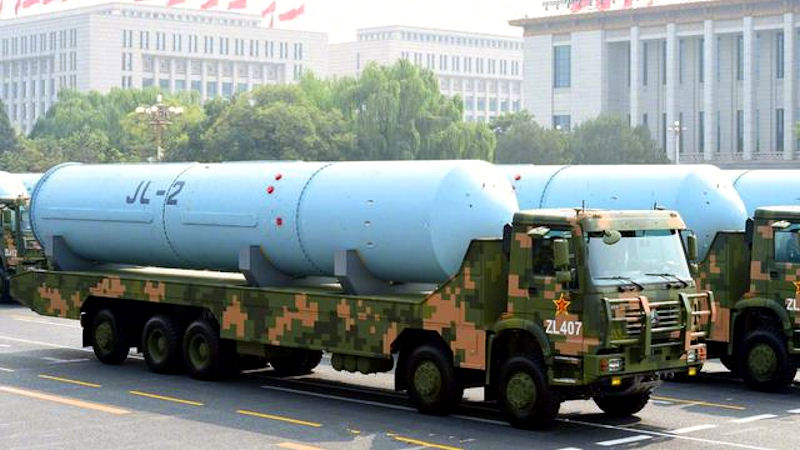
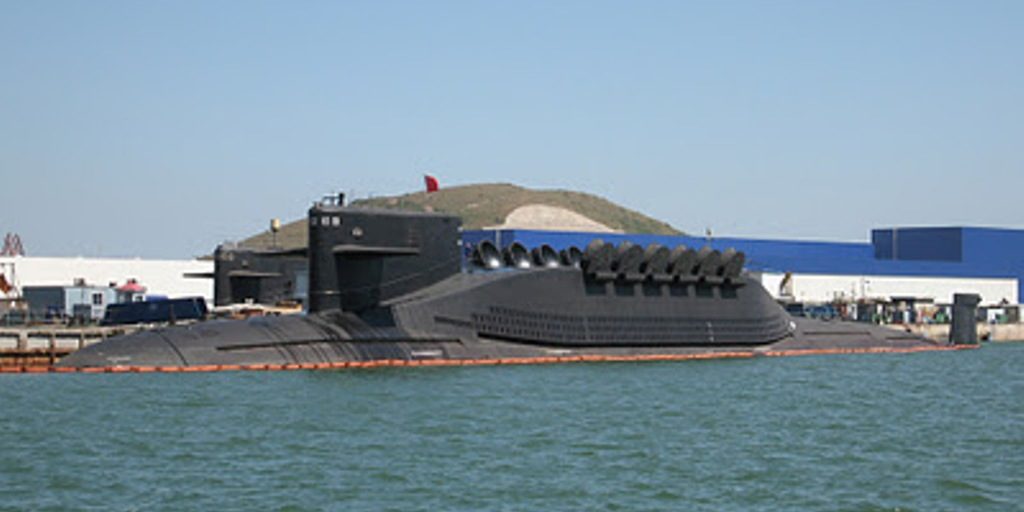
The JL-2 (Chinese: 巨浪-2; pinyin: Jù Làng Èr; lit. 'Giant Wave 2', NATO reporting name CSS-N-14) is a Chinese second-generation intercontinental-range submarine-launched ballistic missile (SLBM) deployed on the People's Liberation Army Navy's (PLAN) Type 094 submarines. It succeeds the JL-1 SLBM deployed on the Type 092 submarine.
The JL-2 provides China with its first viable sea-based nuclear deterrent.
Development
The JL-2 is a naval variant of the land-based DF-31. Their common 2-metre diameter solid fuel rocket motor was successfully tested in late 1983, and research and development efforts were reorganized starting in 1985 to produce both missiles.
The first JL-2 at-sea launch occurred in 2001 from a Type 031 submarine. The program was delayed after a failed test in 2004. Successful launches occurred in 2005 and 2008. The missile was successfully fired from a Type 094 submarine, the intended operational platform, for the first time in 2009. A series of test launches occurred in 2012.
During the development of the missile, it was reported that China was considering modifying the missile to accommodate an anti-satellite warhead to give it a sea-based anti-satellite capability.
Type 094 deterrence patrols with JL-2 missiles began in December 2015.
As of 2017, 48 JL-2 launchers are deployed on submarines.
Description
The JL-2 is a three-stage, solid-fueled missile, with a maximum range of 7,200 km (4,500 mi). Its payload is a single 1 Megaton warhead or 3-8 MIRVs with yields of 20, 90, or 150kt.
References
Citations
Sources
External links
- CSIS Missile Threat - Ju Lang-2
- JL-2 from Mark Wade's Encyclopedia Astronautica